Your bathroom sink drains slowly because hair and soap scum are wrapped around the pop-up stopper and packed into the drain body below it. The hole looks clear, which is why most people pour in a chemical cleaner first. Pull the stopper out and run the tap: if it drains freely, that was the clog. If it still crawls, the restriction is in the overflow channel or the trap, and those need different fixes. One test tells the three apart.
Safety first
- Never mix drain cleaners, and never plunge a drain with cleaner in it. Caustic cleaners burn, and a plunger can throw the liquid back out of the overflow slot. If one is already in there, goggles and gloves, ventilate, follow the label.
- Do not pour boiling water into the trap or tailpiece. It deforms the thin plastic they are made from. Hot tap water is the safe version.
- Put a bucket and a towel under the trap first. It holds water by design and it will come out.
- Hand-tighten plastic slip nuts. A wrench cracks them, and the drip starts where you cannot see it.
- Stop if water comes up in the tub, shower or toilet when the sink drains, or if the cabinet floor is stained or soft. A shared line or a leak is not a sink clog.
Three problems that look the same
Water circling the bowl is the same symptom for three faults:
- Hair and soap scum on the stopper and its stem. The pipe is open; the entrance is plugged.
- A coated overflow channel. The basin's second opening near the rim runs through a channel inside the porcelain to the drain. Moen describes that path. Nobody scrubs it, and it bypasses the stopper — which is why a plunger loses its push unless you seal the slot first.
- A plug in the trap or the branch line past it. The entrance is clear; the pipe below is narrowed.
Only the first is a five-minute fix, and it is the one most sinks have.
The stopper-out test
Ten minutes, usually no tools. Tap off, bowl empty.
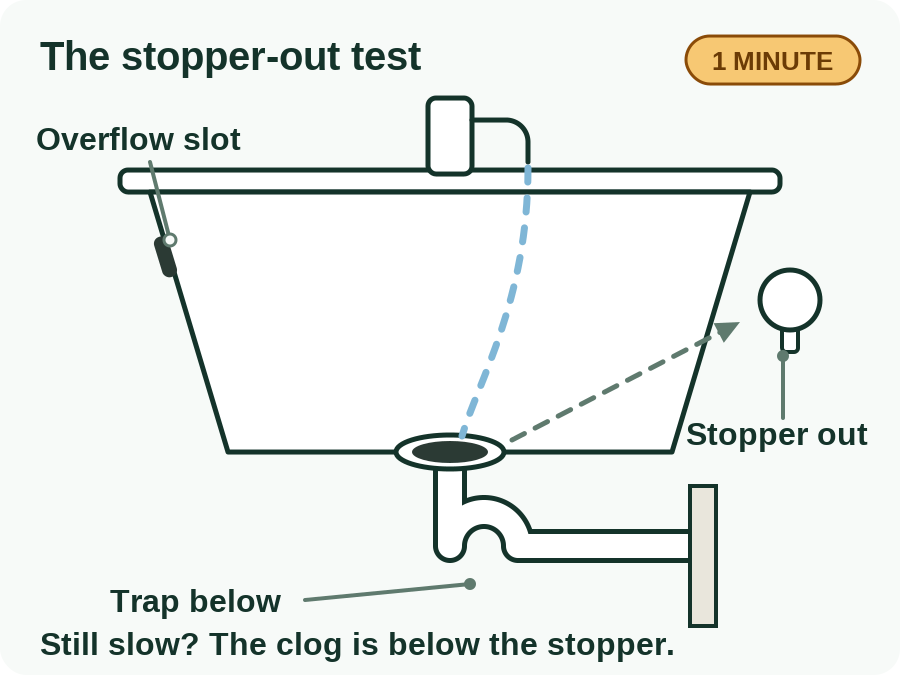
- Open the stopper, then lift it out. Push-button and pop-down drains pull straight up; Delta says to turn the stopper a quarter turn to unlock it on the overflow version, and to pull straight on the version without overflow holes. On a lift-rod drain, loosen the pivot rod nut under the sink by hand, pull the rod back an inch, and lift the stopper out.
- Look at the stem. Hair wraps the stem and the crossbars.
- Run the tap at your normal flow and watch the drain hole for one minute, not the bowl.
- Pour a cup of water into the overflow slot at the rim.
What the results mean:
- Free with the stopper out, slow with it in. The clog is on the stopper. Clean it and refit.
- Still slow, and the slot swallows the cup. The restriction is in the trap or the branch line. Go to cause 3.
- Still slow, and water stands in the slot or runs back out. The channel is coated. Go to cause 2.
- It drains, then gulps, and the toilet bowl twitches. Air is being pulled through a trap elsewhere — a vent problem, not a sink clog.
Cause 1: hair on the stopper and stem
Hair, skin and toothpaste bind to the soap scum coating the inside of a drain, and the buildup starts at the narrowest point — the stopper. Moen's three families of lavatory drain (grid, push-button, lift-rod) all put a stem, cage or strainer in the water path where hair catches.
Why it seems to arrive overnight: the EPA's WaterSense programme puts a standard bathroom tap at 2.2 gallons a minute and a labelled one at 1.5. A drain narrowed by a third still handles a trickle and fails under a normal tap.
Confirm it: stopper out, a phone light, and a gloved finger or barbed plastic strip. The mat sits on the stem and in the first inch of the drain body.
Clear it: pull, do not push — pushing compacts the mat. Work a barbed strip in six to eight inches, twist, draw it out slowly, and repeat until it comes up clean. Rinse the stopper, flush with hot tap water for a minute, refit.
Cause 2: the overflow channel
The slot near the rim is not decoration. It is a second opening into the same drain: Moen's description is that water enters the hole and travels a channel inside the porcelain to the drain at the bottom. So it is a wetted surface that never sees a brush, and because it bypasses the stopper it is the path a plunger's pressure escapes through — trade guidance is to plug the overflow hole with a rag before you start.
A coated channel drains slowly, gulps as the basin empties, and is usually the smell that comes back a week after you cleaned the trap.
Confirm it: the cup test from step 4. Water poured into the slot should disappear at about the rate it disappears down the drain. If it stands in the slot, the channel is blocked.
Clear it: a bottle brush or pipe cleaner worked into the slot and as far along the channel as it reaches, hot water running. Do not force a coat hanger round the bend — it scratches the glaze and pushes the blockage deeper.
Cause 3: the trap and the branch line
If the stopper and the overflow are clear, the restriction is below the basin: the tailpiece, the P-trap, or the branch line into the wall. The trap holds water to seal sewer gas, and it catches everything heavy that gets past the stopper.
Confirm it: bucket and towel under the trap, unscrew the two slip nuts by hand, lower it. A hair plug and grey sludge confirm it. If the trap is clean, the clog is downstream — feed a small hand auger into the trap arm.
Clear it: empty the trap, scrub it with a bottle brush, check the slip washers for cracks, reassemble hand-tight. Run water for a minute and check both nuts for drips.
Do not crank a lavatory branch: a 1¼-inch trap arm is thin-walled, and a hand auger turned with force will kink it.
When it is not the sink
If the sink is slow and so is something else — the tub, the shower, the toilet burping when the sink empties — the fault is in the shared branch or the vent. Plumber Magazine puts it plainly: a slow fixture is normally treated as a drain problem, but once the drain is clear and it is still slow, look beyond the drain. Vents block with debris or animals, or are damaged or installed wrong, and the resulting negative pressure slows drainage and can siphon traps.
Confirm it: two or more fixtures on the same floor slowing together, or gurgling from a drain you are not using. One slow sink is local; several is not.
Clear it: you cannot, from inside the bathroom. The vent runs up through the roof. That is a plumber's job.
When to stop and call a plumber
- Water backs up in the tub, shower or toilet when the sink drains.
- The water that comes back is dirty or smells of sewage.
- The trap or tailpiece is cracked, or a slip nut will not seal after reassembly.
- The trap is glued, or the cabinet is built around it.
- The sink is still slow with the stopper, the overflow and the trap all clear.
- Water is showing on the cabinet floor, the ceiling below, or at an outlet.
- You already poured a chemical cleaner and it did not work. Tell the plumber what and when.
A stopper, an overflow slot and a plastic P-trap are reasonable homeowner work. A vent, a glued trap and a branch line are not.
Troubleshoot it with FixThis
The details that decide this are hard to put in a search box: whether it gurgles, whether the overflow slot takes water, what the stopper looked like, and whether anything else in the bathroom has slowed down.
Describe what yours is doing — a photo of the open drain helps — and FixThis will ask the questions that narrow it down, then tell you what to check next and when to stop. You can start without an account: the first two messages are free, and creating one carries the conversation over.
---
Written from manufacturer and trade documentation by the FixThis editorial team. FixThis is not a licensed plumber; this is general guidance, not an inspection.
What's your specific symptom?
Describe what you're seeing or upload a photo.
You are texting the AI assistant for FixThis. It is not a licensed professional, and it gives general guidance — not professional inspection or diagnosis. If you smell gas, see active flooding, sparks, or fire, or believe there is immediate danger to people or property, leave the area and call 911 or your utility.
Sources
- https://solutions.moen.com/Article_Library/Lavatory_Drains
- https://www.moen.com/pages/faqs
- https://support.deltafaucet.com/s/article/Push-Pop-Drain-Assemblies-RP101630-RP101631-RP101632
- https://www.epa.gov/watersense/bathroom-faucets
- https://www.plumbermag.com/online_exclusives/2026/11/diagnosing-venting-problems-and-understanding-air-admittance-valves
- https://www.plumbermag.com/online_exclusives/2026/06/the-sink-drain-details-you-didnt-know-to-look-for