A disposal that hums is getting power, but the plate is stuck — often on something hard, such as a bone, a utensil, glass, or food packed against the ring. The first job is to switch the power off and turn the plate with the wrench described below. That check separates a jam you can clear from a motor that needs service. Never put your hand into the chamber.
Safety first
This is a moderate-risk job. The hazards are line voltage under a wet sink and a grinding chamber that can injure a hand, not the food scraps.
- Unplug a corded unit. If it is hardwired, switch off its dedicated breaker and leave a note on the panel. A wall switch alone is not proof that the unit is dead.
- Never put your hand into the grinding chamber. Not to check, not to pull something out. Use tongs or pliers.
- After the power is off, bail standing water. Do this before the wrench test. A sink full of water plus a live circuit is the combination to avoid.
- Do not hold the switch on while it hums. A stalled motor heats quickly. Make one attempt after a fix, then stop.
- If water is dripping from the disposal housing, or water is at an outlet or cord, switch off the breaker and stop.
- If the breaker trips when you turn the disposal on, stop. A tripped breaker can be a jammed motor or an electrical fault, so it needs diagnosis. Do not keep resetting it.
What the hum is telling you
Inside the disposal, a motor turns a turntable — InSinkErator calls it the shredding disk — and food is thrown outward against a ring. A hum means the switch and the circuit are doing their job: current is reaching the motor, but the rotor is not turning.
That leaves two broad causes. Something mechanical is holding the plate, or the motor cannot start even though the plate is free. The difference matters because the first can be a homeowner fix and the second is a service or replacement call.
A third possibility is the overload protector. It is a red button on the bottom of the unit that cuts power when the motor overheats or jams. A tripped protector leaves the unit silent, so check the button if it hummed and then stopped.
The 15-minute wrench test
This is the check InSinkErator publishes for a jammed disposer. Set aside about 15 minutes; the time depends on how tight the space under the sink is. You need a 1/4-inch Allen wrench (or the small wrench that came with the unit), a flashlight, tongs or pliers, and a towel or shallow bucket.
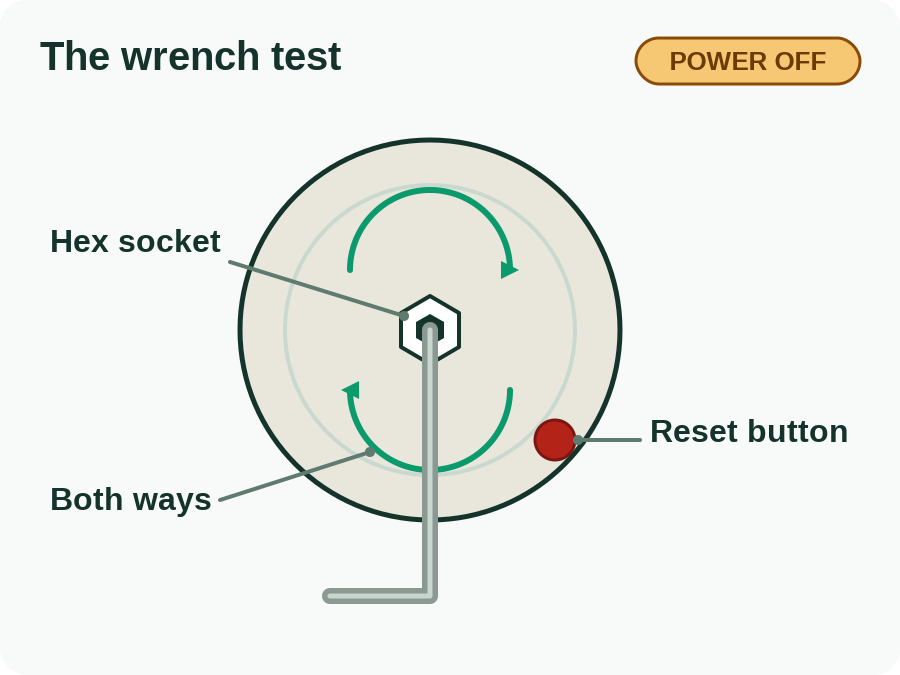
- Kill the power. Unplug a corded unit. For a hardwired unit, switch off the breaker. Do not test the breaker by turning the disposal on; if you cannot confirm the power is off, stop and call an electrician.
- Bail the sink. If water is standing, scoop it into the bucket so you can work without a flood.
- Put the wrench in the bottom center hole. Many disposals have a hex socket under the unit, facing the floor; InSinkErator ships a wrench for it. Work the wrench back and forth in both directions until it turns freely in complete circles. Some resistance is normal, and InSinkErator says it is OK to use some force because the wrench is designed to bend before the disposal is damaged. If it still will not turn, stop.
- Look inside with the flashlight. Do not reach in. If you can see the object, pull it out with tongs or pliers. Pay attention to the outer edge of the plate, where the teeth are.
- Check the red reset button. It is on the bottom, facing the floor. If it has dropped about a quarter of an inch, press it gently. If it will not stay up, wait 10 to 20 minutes depending on the model, then try once more.
- Test it once. Turn on cold water, then the switch, for two or three seconds. If it hums again, stop. Do not keep resetting it.
What the test tells you
- The wrench turns freely, and the unit runs after you remove the debris. You had a jam. Clear the chamber, then run the disposal with a moderate flow of cold water, as InSinkErator advises.
- The wrench turns freely, but the unit still hums. The plate is not stuck. The motor or its start circuit is the problem. Stop resetting it and arrange service or replacement.
- The wrench moves only with firm pressure, then spins. A jam was binding the plate. Clear it and test once. If it binds again, stop.
- The wrench still will not turn after a firm attempt. Stop. The plate or motor is seized; this is a service call.
- The red button is down and stays up after a reset. The overload did its job. Run the unit briefly and watch for a repeat.
- The red button will not stay up. The motor is still jammed or has failed. Stop.
- Water is visible at the housing, cord, or outlet. Do not touch the cord or outlet. Switch off the disposal circuit at the breaker from a dry location and stop. Water and electricity are the emergency here.
The likely causes, in order
1. A hard object is jammed between the plate and the ring
This is the first thing to rule out. Bones, fruit pits, a bottle cap, a piece of glass, a utensil, or a wad of fibrous food can wedge the plate. The wrench test confirms it: the plate moves once the object is out. A flashlight and tongs are the tools for this. If the object is glass, wear eye protection and use pliers, not your fingers.
2. The plate is free but the motor cannot start
If the wrench turns in full circles and the hum remains, the jam is not the problem. The motor or its start circuit may have failed. There is no safe homeowner fix for that beyond confirming the plate is free. Repeated attempts to start a stalled motor can overheat it or trip the breaker, so stop after one try.
3. The overload protector has tripped
The red button is an overload switch, not a reset for a jam. If the unit hummed, stopped, and now does nothing, the button may be down. Press it once. If it pops again immediately, the motor is still bound or failing; do not keep pressing it.
4. The power is not actually reaching the unit
If there is no hum at all, this is a different problem: the breaker, a GFCI, the wall switch, or the cord. InSinkErator's troubleshooting sequence starts with the breaker, then tests the switch and outlet. A humming unit is not in this group, but it helps to know before you buy a part.
When to stop and call a pro
- The wrench will not turn after a firm attempt.
- The unit hums again on the first test after you clear it.
- The breaker trips or the reset button will not stay up.
- Water is at the disposal housing, the cord, or an outlet.
- You smell burning, see smoke, or hear metal grinding.
- There is broken glass in the chamber you cannot remove with tongs.
- The unit is hardwired and you cannot confirm the breaker is off.
A jammed disposer is a reasonable homeowner fix. A motor replacement, a hardwired connection, or a disposal that keeps tripping the breaker is not. That is the point to hand it over.
Related guides
If the sink also drains slowly or the dishwasher backs up, the two problems may share a drain path. More symptom-first guides are on the FixThis learn hub.
Written from manufacturer documentation by the FixThis editorial team. FixThis is not a licensed plumber or electrician; this is general guidance, not an inspection. Procedures vary by model, so check your disposer's own instructions.
What's your specific symptom?
Describe what you're seeing or upload a photo.
You are texting the AI assistant for FixThis. It is not a licensed professional, and it gives general guidance — not professional inspection or diagnosis. If you smell gas, see active flooding, sparks, or fire, or believe there is immediate danger to people or property, leave the area and call 911 or your utility.