If water is pooling at the base of your kitchen faucet, the base is almost never where the leak is. The water is arriving from one of three places — a seal inside the spout, the valve under the handle, or a connection below the counter — and the base is just where it shows. Which one you have decides whether this is a ten-minute part swap or a call to a plumber. Three dry paper towels tell you which in ten minutes.
Safety first
Nothing here is dangerous if you keep water away from power and stop when a valve will not turn.
- Find your shutoffs before you loosen anything. The two angle stops under the sink are the ones you will use. If either will not close, or weeps from the stem when you turn it, stop and shut the house main instead.
- Water and power share that cabinet. A disposal, a dishwasher connection, and often a receptacle sit under the sink. If water is reaching a cord, an outlet, or an appliance junction, switch the circuit off at the breaker before you touch anything.
- The hot side is hot. Kitchen hot water can be hot enough to scald. Run the cold side first and let the fittings cool before you put a hand in.
- Do not overtighten. Plastic cartridges, brass threads, and sink rims crack or strip. Snug by hand, then a quarter turn.
- Water damage is the expensive part. If the cabinet floor is swollen, soft, or stained, you already have damage. Dry it out and fix the leak before it spreads.
Why the base is almost never the leak
Three families of leak look identical from standing height.
Above the deck. Kohler splits these two ways by timing. A leak that appears only while the water is running is usually the seals — O-rings or bearings — in the base of the faucet body. A leak that continues after you shut the faucet off is the valve, also called the cartridge, under the handle.
At the deck joint. The escutcheon gasket and the mounting nut. Splash water gets under the base and seeps back out around the counter.
Below the deck. Kohler's below-deck guide walks the same three suspects in order: the supply hose where it meets the supply stop, the hoses where they meet the spout or valves, and a tee connection. Water runs down the shank and shows up at the base from underneath.
Same puddle. Three different parts.
The ten-minute three-towel test
You need three paper towels, a dry cloth, and a flashlight. No tools.
- Dry everything first. The faucet, the counter around the base, and the cabinet floor under the sink. A wet start tells you nothing.
- Place three dry paper towels. One wrapped around the handle, one around the base where it meets the counter, one around the shank and supply connections under the sink.
- Run the water for 60 seconds. Normal flow. Watch the three towels while it runs.
- Shut it off and wait five minutes. Do not wipe anything. Look again.
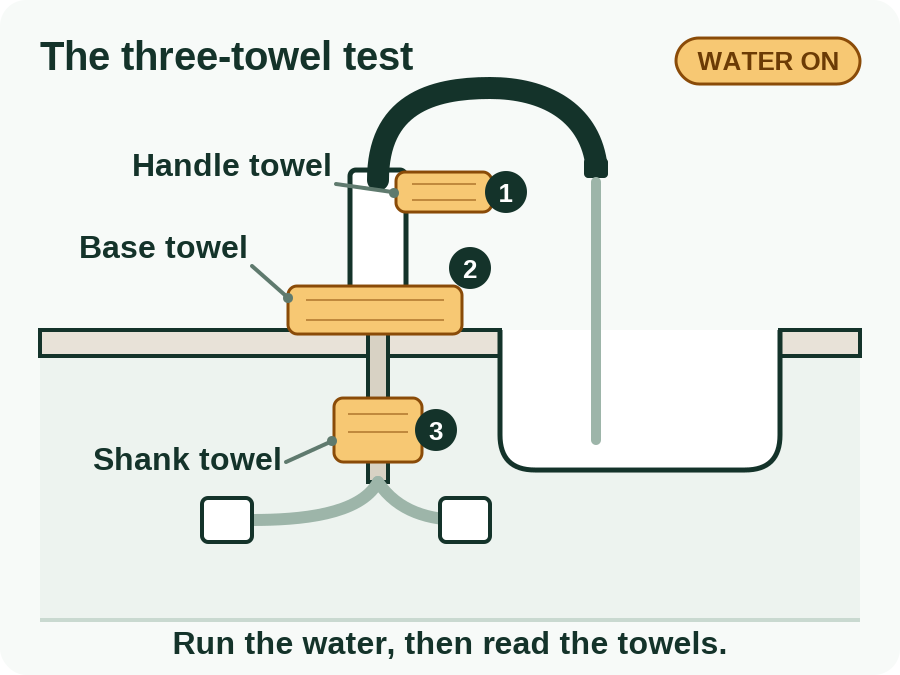
What the towels tell you:
- Handle towel wet, base towel dry. The valve or cartridge under the handle is leaking, and the water is running down the body. This is Kohler's continuous leak.
- Base towel wet only while the water runs, handle towel dry. The seals in the base of the body are worn or torn. This is Kohler's temporary leak.
- Top towels dry, under-sink towel wet. The leak is below the deck: a supply connection, a tee, or the spray hose.
- All three dry now, but water appears after half an hour. A slow valve leak. Check the handle towel again before you rule the cartridge out.
- Base wets only when you swing the spout side to side. The spout swivel O-rings, not the cartridge.
- Base wets only when you pull out the sprayer. The hose-to-wand connection or the vacuum breaker inside the spout receptor. Moen lists both.
The likely causes, in order
Timing matters for more than the diagnosis. A leak that only shows while the tap is on is annoying; one that drips around the clock is expensive. The EPA puts a faucet dripping once a second at more than 3,000 gallons a year.
1. The seals at the spout base
Confirm it: the base towel wets while the water runs and stops when you shut the faucet off. Fix: the seal kit for your model. Seals differ by model, so identify the faucet before ordering. Lubricate the new O-rings with silicone grease only — Moen warns that petroleum-based grease reacts with the rubber and can make the spout stiff to move.
2. The valve or cartridge under the handle
Confirm it: the handle towel wets, or water reappears at the base minutes after the faucet has been off. Fix: Kohler's first step is tightening the nut that holds the valve. If that does not stop it, debris has collected in the valve and it has to be replaced. Some faucets also carry a check valve, or spacer, beneath the valve; Kohler says to replace that at the same time.
3. A connection below the counter
Confirm it: the under-sink towel wets while the top stays dry, and the cabinet floor is damp. Fix: work Kohler's order — the supply hose at the stop, the hose at the spout or valve, then a tee. Most of these are a tighten or a new hose. A damaged supply stop is a plumber job, because the water has to be off at the main to change it.
4. The deck seal or a loose mounting nut
Confirm it: the base wets only when you splash the counter or use the sprayer, the faucet rocks slightly, or the puddle sits around the escutcheon instead of running down from the spout. Fix: re-seat the escutcheon gasket and snug the mounting nut from below with a basin wrench. On a three-hole install, Kohler's guide beds the escutcheon in stainless (non-staining) plumber's putty — regular putty can stain stone — then tightens the washer and nut under the sink.
5. The pull-out or pull-down parts
Confirm it: the leak only appears when the wand is out and the sprayer is in use. Fix: check the screen washer or O-ring where the hose meets the wand, then the vacuum breaker in the spout receptor. Both are model-specific parts from the manufacturer.
When to stop and call a pro
- A shutoff will not close, or weeps when you turn it. Anything below that valve needs the house main off.
- Water is at a cord, an outlet, or an appliance junction and you cannot isolate the circuit.
- The cabinet floor, the counter, or the wall is soft, swollen, or stained. That is water damage, and it needs drying out, not just a new O-ring.
- The faucet body is cracked, or the base is still wet after you replaced the seals and the cartridge.
- It is a two-handle or remote-handle faucet with a sidespray. Kohler routes those to customer service because several parts are involved and the order matters.
- You cannot identify the model. A seal kit or cartridge for the wrong model will not seal, and the leak gets worse.
A seal kit and a cartridge are reasonable homeowner parts. Replacing a supply stop, a cracked body, or a faucet that has already had two repairs is not.
Troubleshoot it with FixThis
"Leaks at the base" is not enough to pick a part, but one detail usually is: does it leak with the faucet off, only while it runs, or only when the sprayer is out? That single answer cuts the list from five parts to one.
Describe what you are seeing — or send a photo of the open cabinet under the sink — and FixThis asks the questions that separate the three leak paths, then tells you which part to buy and when to stop. You can start without an account: the first two messages are free, and creating one carries the conversation over.
Written from manufacturer and EPA documentation by the FixThis editorial team. FixThis is not a licensed plumber; this is general guidance, not an inspection. Procedures vary by model, so check your faucet's own documentation.
What's your specific symptom?
Describe what you're seeing or upload a photo.
You are texting the AI assistant for FixThis. It is not a licensed professional, and it gives general guidance — not professional inspection or diagnosis. If you smell gas, see active flooding, sparks, or fire, or believe there is immediate danger to people or property, leave the area and call 911 or your utility.
Sources
- https://www.kohler.com/en/support/help-and-faq/kitchen-faucet-leaking-at-base-of-faucet-spout
- https://resources.kohler.com/webassets/kpna/catalog/pdf/en/1265908_17.pdf
- https://solutions.moen.com/FAQ's/FAQ's-Troubleshooting/Kitchen/Kitchen_faucet_leaks_at_the_bottom_of_the_spout
- https://solutions.moen.com/Article_Library/Bathroom_Faucet%253A_Leaking_Around_the_Base_of_the_Faucet
- https://techcomm.kohler.com/techcomm/pdf/1015079-2.pdf
- https://www.epa.gov/watersense/fix-leak-week