A puddle at the front of the refrigerator that appears once or twice a day is almost always meltwater from the defrost cycle that never reached the drain pan. A puddle at the back that keeps growing is water from the ice maker supply. Those are different repairs, and one 24-hour test tells them apart without pulling the fridge out.
Safety first
This is mostly a water-damage problem with two sharp edges: the fridge is heavy, and there is line voltage behind it.
- If water has reached the cord, an outlet, or a power strip, do not touch it. Switch that circuit off at the breaker from a dry spot, then call an electrician. The fridge outlet sits behind the unit, where a rear leak pools.
- Unplug the refrigerator before you reach behind or under it, and move it with two people. Beko is explicit about the unplugging, and about the compressor: it can be very hot.
- Never chip ice out of the freezer with a knife. The evaporator coil sits behind it, and a puncture is a sealed-system repair.
- Mop up the same day. Laminate and wood swell; a wet cabinet base rusts.
Two kinds of water, one puddle
A frost-free refrigerator makes water on purpose. Frost collects on the evaporator, a heater melts it on a schedule, and the meltwater runs down a drain tube to a pan under the cabinet where it evaporates. That is why a defrost leak has a rhythm: GE describes the classic case as water on the floor in front of the fridge once or twice a day.
A fridge with an ice maker or dispenser has a second source — a supply line from the house, through an inlet valve, a filter, and often a storage tank. So the puddle is either water the fridge made and could not get rid of, or water the house sent and could not keep in the line.
The pair that fools people most both show up under the crisper drawers: in a side-by-side, GE lists a clogged defrost drain and a leaking storage tank as the two causes there.
The dry-and-isolate test
Fifteen minutes to set up, then read it the next day. You need dry towels and a flashlight.
- Turn the ice maker off. GE's instruction before you shut the water; your manual has the model-specific steps.
- Shut the supply valve. On most fridges the connection is at the back, usually on the right as you look at it. Follow the line to the house supply — often under the kitchen sink — and turn that valve clockwise.
- Dry the floor completely, then lay a dry towel under the front edge and a second one behind the fridge.
- Wait 24 hours. Do not dispense water. The defrost cycle runs at least once in that window.
- Pick up both towels.
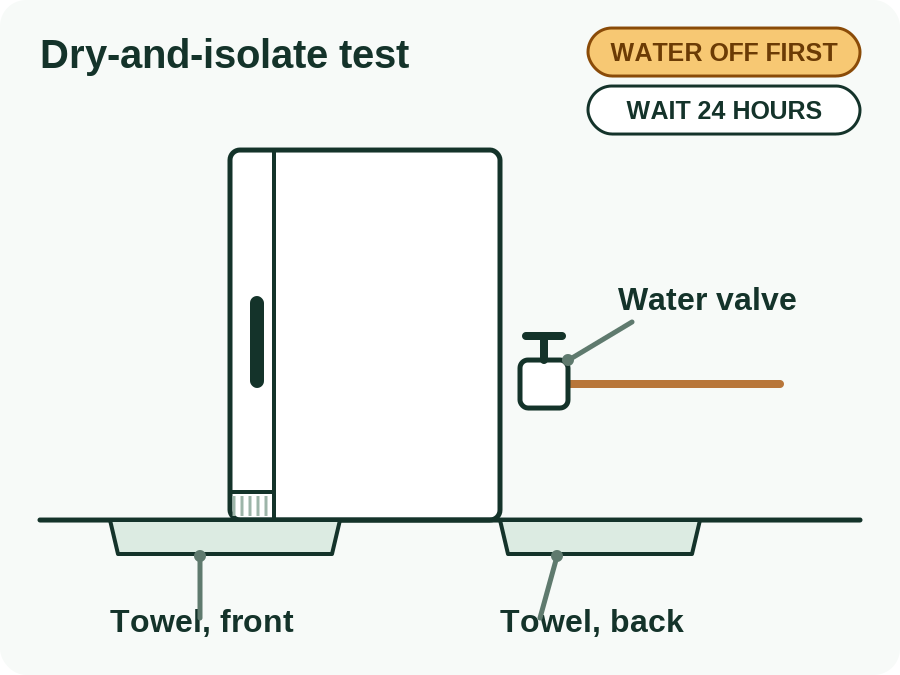
What the result means:
- Both towels dry. The fridge is not shedding its own meltwater, so the water arrives through the supply side: line, fitting, valve, filter housing, or tank.
- Front wet, back dry. The fridge is making the water and losing it at the front: a blocked defrost drain, or a cabinet tipped forward. If the door swings open on its own, it is the tipping.
- Back wet with the valve shut. The drain pan in the machine compartment is the suspect — cracked, displaced, or overflowing.
- Water inside the cabinet, or ice on the freezer floor, before you finish. Stop the test; that is the defrost drain.
Ranked causes, and how to confirm each
1. The defrost drain is clogged or frozen
Frigidaire calls this the most common cause of a floor leak. GE's description is specific: water in front of the fridge once or twice a day, plus ice under the bottom basket in the freezer. In a top-freezer, Sears describes the same water pooling under the crisper drawers.
Confirm it: open the freezer and look at the back wall and floor. Ice there, or water under the crisper drawers, is the drain backing up. On GE side-by-sides the drain hole is sometimes behind a plastic panel held by one screw; if you see no drain hole at all, GE says service is required.
Clear it, if your manual covers it: GE's procedure is one tablespoon of baking soda in two cups of hot — not boiling — tap water, squirted in with a turkey baster. When the drain is clear you will hear water running into the pan below.
Do not pour water in if the drain is packed with ice, and do not pull the evaporator cover unless your manual shows that job. Built-in and most freestanding models need service.
2. The supply line, inlet valve, or filter housing is leaking
Everything here leaks only while the valve is open — what the towel test separates. GE lists three suspects: a water valve stuck on and flooding, a loose or split copper supply line, and a loose or split plastic fill line to the ice maker. Frigidaire adds the internal plastic lines, which go brittle and crack, plus the filter housing and head.
Confirm it: with the supply on, dry the fitting and wrap it in a dry paper towel. Check after an hour. A damp towel, or white mineral crust around a nut, is your leak; a split line shows as a wet run along the tube.
The storage-tank exception: on a side-by-side with a dispenser, water under the vegetable bins can be the tank rather than the drain. GE's check: pull the drawers, leave the door open, and dispense water into a glass while watching the tank. If it leaks, GE says it will be obvious — and it is a service part.
3. The drain pan is cracked, displaced, or overflowing
The pan is the end of the drain path, and the cause people miss because it sits underneath. Frigidaire explains the design: the condenser fan blows warm air across the pan so the water evaporates, so it never needs emptying. A crack defeats that, and it drips during the defrost cycle. Beko's tray sits on top of the compressor and can work loose.
Confirm it: water at the bottom centre of the unit, or a wet patch under the middle. Where it is reachable, unplug the fridge, pull the machine-compartment cover, and look for cracks or standing water. GE notes that on 1987-and-newer models the pan is fixed and not easily accessible — there, a wet pan area is a service call.
Overflow rather than a crack: an intact, full pan means more meltwater than it can evaporate, often from a torn door gasket.
4. The cabinet is tipped forward
Samsung's guidance is that the appliance should sit tipped slightly backwards, so condensation reaches the drain and the door swings shut by itself.
Confirm it: open the door halfway and let go. It should close on its own. If it stays put, raise the front legs a turn at a time until it does.
When to stop and call a pro
- Water is at the cord, the outlet, or the breaker panel.
- The water valve is stuck open or flooding, the copper line is split, or the shutoff under the sink will not close.
- You cannot see a defrost drain hole, or the fridge is a built-in. GE says service.
- Ice returns to the freezer floor after the drain is cleared — that points at the defrost heater or control.
- The drain pan is cracked on a model where it cannot be removed.
- The floor is soft, the cabinet base is rusting, or the wall behind the fridge is damp.
A drain you can flush, a towel you can move, and a fridge you can level are reasonable homeowner work. A stuck valve and a split copper line are not.
Troubleshoot it with FixThis
"A puddle every morning, dry by lunch" and "a puddle growing since Tuesday" point at different halves of the refrigerator, and "water under the crisper drawers" narrows it again.
Describe what you are seeing — when it appears, where it pools, whether the freezer floor has ice — and add a photo if you have one. FixThis asks the questions that separate the causes, then tells you what to check next and when to stop. You can start without an account: the first two messages are free, and creating one carries the conversation over.
---
Written from manufacturer documentation by the FixThis editorial team. FixThis is not a licensed appliance technician or plumber; this is general guidance, not an inspection. Procedures vary by model, so check your refrigerator's own manual.
What's your specific symptom?
Describe what you're seeing or upload a photo.
You are texting the AI assistant for FixThis. It is not a licensed professional, and it gives general guidance — not professional inspection or diagnosis. If you smell gas, see active flooding, sparks, or fire, or believe there is immediate danger to people or property, leave the area and call 911 or your utility.
Sources
- https://products.geappliances.com/appliance/gea-support-search-content?contentId=19366
- https://products.geappliances.com/appliance/gea-support-search-content?contentId=21865
- https://products.geappliances.com/appliance/gea-support-search-content?contentId=17475
- https://products.geappliances.com/appliance/gea-support-search-content?contentId=16666
- https://www.samsung.com/uk/support/home-appliances/what-should-i-do-if-i-suspect-my-samsung-fridge-freezer-is-leaking-water/
- https://beko.co.uk/support/faqs/fridge-freezers/bottom-of-inside-of-fridge-freezer-is-wet
- https://frigidaireapplianceparts.com/RepairHelp/How-To-Fix-A-Refrigerator/59---/Refrigerator-Leaking-Water