If your shower drains slowly, the cause is usually a mat of hair and soap scum sitting on the strainer or in the first few inches of pipe below it. Lift the cover, hook the mat out, and most drains come back. If the pan still holds water with the cover off, the blockage is further down — or the vent is blocked, which looks the same and needs a completely different fix. One test tells those three apart, and it takes about a minute.
Safety first
Standing water on tile is slippery, and these checks put your hands near sharp edges and, sometimes, caustic chemicals.
- Do not mix drain cleaners, and never plunge a drain that has cleaner in it. Moen's guidance is to start with the gentlest method and work up, and it warns that caustic soda can cause chemical burns. If you use any chemical, wear goggles and gloves and ventilate the room.
- Do not pour boiling water into PVC pipe. It can soften and deform it. Hot tap water is the safe version of that flush.
- Do not force the drain cover. Moen's shower covers are either screwed in with two screws or snapped into a 3-inch drain opening. A tile-in or linear drain grate may be tied into the waterproofing. If it will not lift with light finger pressure, leave it alone.
- Stop if water is coming up somewhere else — the tub, the sink, or a floor drain. That is a shared line, not your shower.
- Stop if water is at a light fixture or an outlet, or staining the ceiling below. Switch off that circuit at the breaker and call.
Three problems that look the same
Water rising around your ankles is the same symptom for all three:
- A mat of hair and soap scum on the cover or just below it. The pipe is open; the entrance is blocked.
- A clog past the cover, in the trap or the branch line. The entrance is clear; the pipe is narrowed.
- A blocked vent. The pipe is clear; air cannot get in behind the water, so the drain gulps and runs slow.
Only the first is a five-minute fix, and it is the one most people have. Check it before you buy a snake or pour anything down the drain.
The one-minute cover-off test
This separates "blocked at the entrance" from "blocked in the pipe". Do it with the shower off and the floor dry.
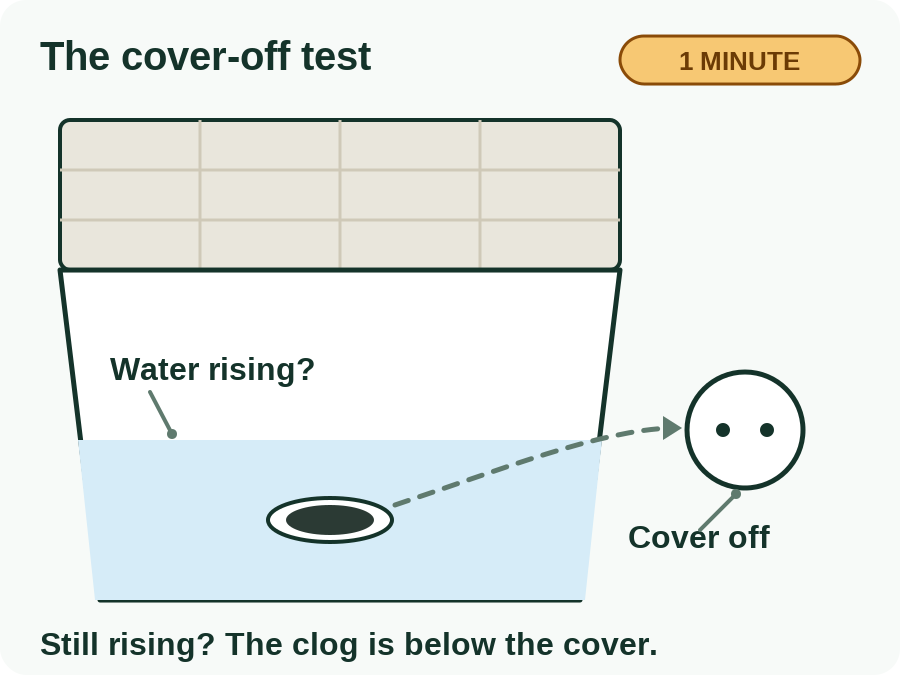
- Let the standing water go down, or bail it into a bucket if it will not.
- Remove the cover. Two screws means unscrew it. No screws means it snaps in: lift one edge with a fingernail or a plastic scraper. If it will not move, stop here.
- Run the shower at the flow you normally use and watch the drain for one minute — not the floor, not the showerhead.
- Read the result against the list below.
What the test tells you:
- It drains freely with the cover off, but pooled with it on. The mat is on the cover or in the inch of pipe under it. Clean it, refit the cover, done.
- It still rises with the cover off. The restriction is below the cover. Go to causes 2 and 3.
- It drains, but gurgles as it goes, or the toilet bowl bubbles. Air is being pulled through a trap. That points at the vent or a shared branch, not at your shower.
- It drains slowly but never rises. Early partial clog. Run a barbed hair strip through it now, before it becomes a stoppage.
Cause 1: the mat at the strainer
This is the common one, and it is not only hair. Moen describes the mechanism plainly: hair, skin, and dirt bind to the soap scum that coats the inside of drain pipes, and the buildup narrows the opening until flow drops. The EPA's WaterSense program puts a standard showerhead at up to 2.5 gallons a minute, so a drain that has narrowed only slightly still backs up under a normal shower — which is why the problem seems to arrive overnight.
Confirm it: cover off, flashlight, gloved finger or a barbed plastic strip. The mat sits on the crossbars and in the first few inches below them.
Clear it: pull, do not push. Pushing compacts the mat against the pipe wall and makes the next attempt harder. Work the strip in six to eight inches, twist, and draw it out slowly. Repeat until it comes up clean, then flush with hot tap water for a minute.
If you have a hair catcher fitted, that is the mat — lift it out and clean it before you look any deeper.
Cause 2: a clog past the cover
If the cover is clear and the pan still fills, the blockage is in the trap or the branch line. On a shower, the trap sits below the floor, not behind an open cabinet.
Confirm it: a hand snake or auger fed through the open drain meets resistance within the first foot or two if the clog is local. Moen notes that snakes clear clogs close to the fixture while an auger reaches further into the line.
Clear it: feed slowly, crank, and pull back rather than forcing. Moen warns that snakes and augers used incorrectly can damage or puncture pipes, and older drains are the ones that suffer. If there is an access panel behind or below the shower, work through that instead of through the drain.
Do not cut a finished ceiling to reach the trap. That is where the job changes hands.
Cause 3: a blocked vent
Every drain needs air behind the water. When the vent is blocked, water moving down the pipe pulls a vacuum, and the drain slows or gulps. Plumber Magazine puts the diagnostic order well: a slow fixture is usually treated as a drain problem, but when the drain has been cleared and the problem persists, look beyond the drain. Vents get blocked by debris or animals, or are damaged or installed wrong, and the resulting negative pressure both slows drainage and can siphon water out of traps.
Confirm it: the shower is not the only fixture affected. The bathroom sink drains slowly too, the toilet bowl level drops or bubbles when the shower runs, or you hear gurgling from a drain you are not using. One slow fixture is almost always a local clog; several slowing together points at the vent or a shared branch.
Clear it: you cannot, from inside the bathroom. The vent runs up through the roof, and reaching it means roof access. This is a plumber's job.
What this is not
If the showerhead itself runs weak — a thin spray rather than water that will not go down — you have a supply problem, not a drain problem. Delta's support guidance points at the debris screen and flow restrictor in the showerhead for exactly that symptom. Clearing the drain will not fix it, and rinsing the screen will not fix a slow drain.
When to stop and call a plumber
- Water backs up into the tub, the sink, or a floor drain when the shower runs.
- The water that comes up is dirty or smells like sewage.
- The drain cover will not come off without force, or the drain body is loose, cracked, or pulling away from the pan.
- The only access to the trap is a finished ceiling.
- You have cleared the cover and snaked the trap, and it is still slow.
- Water is showing on the ceiling below, or at a light or outlet.
- You already poured a chemical cleaner and it did not work. Tell the plumber what you used and when.
A mat at the strainer and a shallow trap clog are reasonable homeowner work. Vent repairs, cutting a ceiling, and replacing a drain body are not.
Troubleshoot it with FixThis
The useful details here are the ones that are hard to describe in a search box: whether it gurgles, whether the sink slows at the same time, whether it drains and then backs up, and what the cover looks like.
Describe what yours is doing — add a photo of the cover and the drain if you have one — and FixThis will ask the questions that narrow it down, then tell you what to check next and when to stop. You can start without an account: the first two messages are free, and creating one carries the conversation over.
---
Written from manufacturer and trade documentation by the FixThis editorial team. FixThis is not a licensed plumber and this is general guidance, not an inspection. Procedures vary by drain model; check your own drain's documentation.
What's your specific symptom?
Describe what you're seeing or upload a photo.
You are texting the AI assistant for FixThis. It is not a licensed professional, and it gives general guidance — not professional inspection or diagnosis. If you smell gas, see active flooding, sparks, or fire, or believe there is immediate danger to people or property, leave the area and call 911 or your utility.
Sources
- https://www.moen.com/press-room/articles/10-easy-ways-to-unclog-your-drains
- https://www.moen.com/blogs/press-room/common-reasons-for-noisy-pipes
- https://solutions.moen.com/Article_Library/Tub_and_Shower_Drains
- https://www.plumbermag.com/online_exclusives/2026/11/diagnosing-venting-problems-and-understanding-air-admittance-valves
- https://epa.gov/watersense/showerheads
- https://support.deltafaucet.com/s/article/Why-does-my-faucet-have-low-water-pressure-1628028366405