A toilet that gurgles while the sink drains is moving air through its trap. Either the drain cannot pull air in — a blocked vent or a failed air admittance valve — or it cannot push water out — a partial clog downstream. The bowl water level tells you which: drops means suction, bubbles or rises means something is pushing back. One ten-minute test separates them.
Safety first
- Sewer gas is always in a drain system, and it can be toxic and explosive. City guidance is blunt: assume dangerous gases are in the sewer. A strong smell, headache, nausea, or dizziness means stop, ventilate, and leave the room.
- Do not pour chemical drain cleaner down. It cannot clear a vent, and it can damage trap parts and splash back when you open the trap.
- Do not plunge if water is already backing up elsewhere. Plunging a shared line pushes sewage out of the lowest opening, usually a shower or floor drain.
- Do not go on the roof. That is the most dangerous part of this job.
- Expect water, and wear gloves. Bucket and towels under the trap. If water reaches an outlet or a cord, switch the circuit off at the breaker and call an electrician.
What the gurgle actually is
Every trap holds a slug of water — the seal — that keeps sewer gas out of the room. Water draining past a trap needs air behind it and air in front of it. The vent does both: it lets air in as water falls, and carries gas out above the roof. Decatur's guidance is that the code requires vents and traps so gas leaves through the roof and not back into the building.
The toilet trap is the biggest, least resistant air path in a bathroom. When a full sink dumps into the shared branch, that slug acts like a piston. If the vent cannot supply air, low pressure downstream of the toilet trap pulls air backwards through the bowl — the glug — and the bowl level drops.
If the pipe downstream is partly blocked, the same water stacks up and compresses the air in front of it. That air escapes the same way, except now the bowl bubbles or briefly rises. Same noise, opposite pressure.
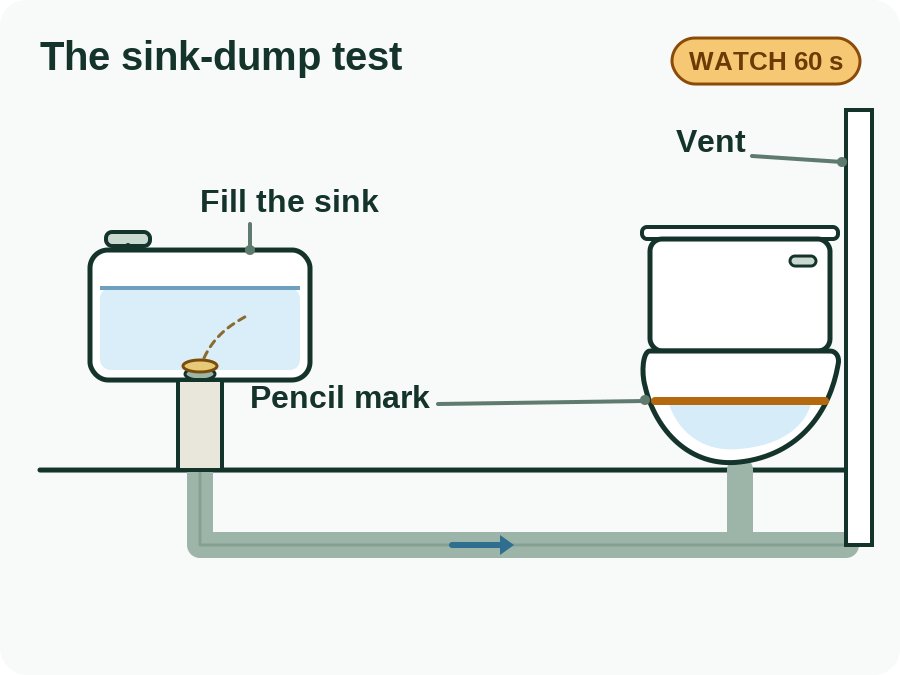
The ten-minute test: dump the sink, watch the bowl
Crane's troubleshooting sheet gives the vent check in one line: fill a basin near the toilet and open the drain; if it drains quickly there is no venting problem. Add a bowl-level check and the result points at one cause instead of three.
You need a pencil or a strip of tape, a phone timer, and a full sink.
- Flush the toilet and let it refill. Wait two minutes so the bowl sits at its resting level.
- Mark the water line in the bowl — a pencil line on the porcelain, or tape with its bottom edge on the line.
- Fill the bathroom sink to just below the overflow slot.
- Pull the plug in one motion and stand where you can see into the bowl.
- Watch for 60 seconds. Note where the level ends up, and listen.
- Level drops and stays down. Air is being pulled through the toilet: suction from a restricted vent, a failed valve, or a branch that was never vented. The drop is the trap seal breaking, and sewer gas now has a path into the room.
- Level bubbles or rises, then settles back. Air is being pushed through the toilet: a partial blockage downstream of the sink connection. Clear the drain, not the vent.
- Level does not move, one soft gurgle at the end. Marginal venting, or a long wet-vented branch. Note when it happens; if the bowl starts dropping, work through the causes below.
- Sink drains slowly and gurgles, toilet quiet. The problem is the sink's own trap or trap arm, not the shared line.
- Water rises in the shower, tub, or a floor drain. Stop — that is a main line problem, not a fixture problem.
Repeat at a trickle: a vent problem goes quiet at low flow; a blockage still gurgles.
Cause 1: the vent is blocked
The bowl-level drop confirms it. A vent stack can be plugged at the roof by leaves, a bird's nest, a wasp nest, snow, or ice, or lower down by a collapsed liner. The whole branch then loses its air supply.
Confirm it: the bowl drops every time; more than one fixture on the stack gurgles; drains are slow with nothing clogged at the fixture; a faint sewer smell appears as the traps empty.
What you can check from the ground: look at the roof vent with binoculars for a nest, matted leaves, or a filled-in bird guard. If you can see a blockage, that is the answer — and it is still a plumber's job, because it means going up there.
Cause 2: the air admittance valve has failed
Remodels and newer bathrooms often vent the sink with an air admittance valve under the cabinet instead of a pipe to the roof. Oatey describes it as a one-way mechanical vent that opens under negative pressure and closes to block sewer gas; their Sure-Vent opens at a pressure change of 0.01 psi.
Failed closed, it behaves exactly like a blocked vent: the sink drains, the toilet gurgles, the bowl drops. Failed open, you get the smell instead.
Find it: a white or black cap on a stub above the trap arm, at least 4 inches above the horizontal branch, within 15 degrees of vertical, accessible and not painted or boxed in. Oatey's field test: unscrew it and shake it hard. You should hear the diaphragm rattle. No rattle means it has failed closed — replace it. Check too that the protective band or foam insert was removed; Oatey warns that leaving it in causes venting failure.
Check local code before buying one: AAVs are not permitted everywhere, and at least one stack vent to the roof is still required. Replacing a valve is a five-minute job and the cheapest thing to rule out.
Cause 3: the drain is partly blocked downstream
A partial clog does not have to be big. Grease, hair, wipes, or roots downstream of the sink connection narrow the pipe enough that a full basin cannot get away.
Confirm it: the bowl bubbles or rises rather than dropping; the sink drains slowly on its own; the gurgle worsens with a second basin and eases after an hour; water in the toilet rises during the dump and drains away slowly.
Which pipe: if only the bathroom group is affected, the clog is in that branch. If the kitchen, laundry, or a basement fixture is also slow, it is further down — the building drain or the lateral. That is the difference between a drain clearing and a main line job, so check the other fixtures first.
Start at the sink's trap and trap arm, which open with a bucket underneath; if those are clear, a hand auger is next. Indian River County's guidance is that gurgling is often heard while the line can still drain, just badly — a glug after the tap is turned off is a blockage sign, not a vent sign.
When to stop and call a pro
- Water rises in a shower, tub, or floor drain when you run the sink or flush.
- More than one fixture is gurgling or draining slowly.
- There is a sewage backup. Stop using water, keep people and pets out, and call your city or sewer district first — many check their main at no charge.
- Sewer smell lingers after you refill every trap.
- The bowl still drops after the vent and valve checks.
- Clearing the vent needs roof access.
- The cleanout is buried or behind finished walls.
Clearing a branch drain and replacing an air admittance valve are reasonable homeowner jobs. Roof work, main line clearing, and sewage cleanup are not.
Sort it out with FixThis
The useful detail is not "it gurgles" — it is which way the bowl went. "Gurgles once when the sink drains and the bowl drops a quarter inch" points at the vent. "Bubbles and the sink takes two minutes to empty" points at the drain.
Describe what yours does — a photo of the open cabinet helps if there is a valve under the sink — and FixThis will ask the questions that narrow it down, then tell you what to check next and when to stop. You can start without an account: the first two messages are free, and creating one carries the conversation over.
---
Written from manufacturer and municipal documentation by the FixThis editorial team. FixThis is not a licensed plumber and this is general guidance, not an inspection. Procedures vary by fixture and by local code, so check your own installation and your municipality's rules.
What's your specific symptom?
Describe what you're seeing or upload a photo.
You are texting the AI assistant for FixThis. It is not a licensed professional, and it gives general guidance — not professional inspection or diagnosis. If you smell gas, see active flooding, sparks, or fire, or believe there is immediate danger to people or property, leave the area and call 911 or your utility.
Sources
- http://www.craneplumbing.com/assets/documents/crane/onlineLiterature/Troubleshooting.pdf
- https://www.oatey.com/resources/project-guides/aav-installation
- https://www.oatey.com/faqs-blog-videos-case-studies/blog/oatey-101-air-admittance-valves
- https://indianriver.gov/The%20Sewer%20Clean%20out.pdf?t=202401310942550
- https://decaturil.gov/277/Sanitary-Sewer-Backups