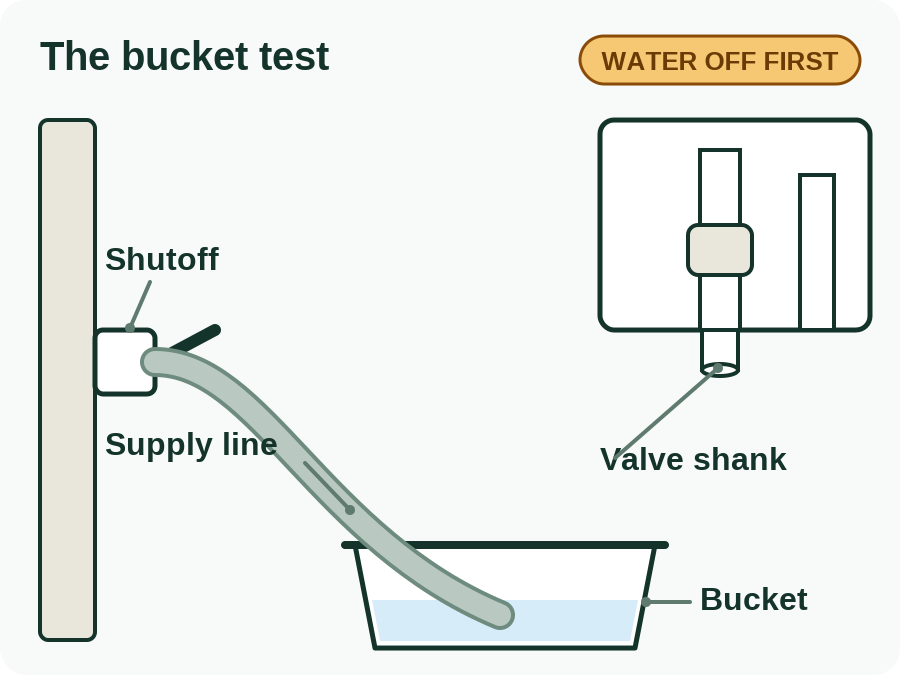
If the tank will not fill, either the water is not reaching the fill valve or the valve is not opening. One test separates those: take the supply line off the valve, point it into a bucket, and open the shutoff for a few seconds. A strong stream means the supply is fine and the valve is the problem. A trickle means the shutoff, the supply line, or the pressure upstream is the problem.
Run it before you buy a part: a fill valve is the usual guess, and often the wrong one.
Safety first
This is a moderate-risk job: the supply line is under pressure, and a shutoff that has not moved in years can fail when you turn it.
What you need: a bucket, towels, and an adjustable wrench or pliers. A plastic cup helps for the valve flush later.
- Know where the house main is. If the toilet stop will not close, the main is your backup.
- Water stays in the line after you close the shutoff. Point the open end into the bucket before you open the valve.
- Hand-tighten the coupling nut. Fluidmaster warns that over-tightening can damage the valve or the nut and cause flooding.
- Do not force a seized shutoff. If the handle will not turn, or the valve leaks at the stem, close the main and call a plumber.
- If water reaches an outlet or a cord, switch that circuit off at the breaker.
- Skip drop-in bleach tablets. Fluidmaster says they damage tank parts, can cause flooding, and void the warranty.
Three problems that look the same
From the doorway they look identical: the tank is empty and the toilet will not flush properly. They need different parts.
- Water is not arriving. The shutoff is closed or part open, the line is kinked or blocked, or the pressure is low. Korky's first check is the shutoff and the line.
- Water is arriving but the valve will not open. Debris or scale inside the valve, a worn seal, or a stuck float. Fluidmaster names debris and age.
- The valve is filling but the tank cannot hold it. A flapper hung open lets water run into the bowl, so the tank drains as fast as it fills.
The bucket test
Korky publishes this as the way to check whether the supply is restricted. It takes about 10 minutes and needs no parts.
- Turn the shutoff off behind the toilet, clockwise, then flush to empty the tank.
- Put the bucket under the fill valve and a towel under the bucket.
- Unscrew the coupling nut joining the line to the bottom of the valve. It is usually hand-tight.
- Aim the open end of the line into the bucket and hold it there.
- Open the shutoff slowly for 3 to 5 seconds, then close it.
- Read the flow.
What the flow tells you:
- Strong, steady stream. The supply is fine and the fill valve is the problem. Go to causes 3 to 5.
- Weak trickle. Something upstream is restricting the flow. Go to causes 1 and 2.
- Nothing at all. The shutoff is closed, the line is blocked, or the house supply is off.
- Water keeps running after you close the shutoff. The stop is not closing. Close the house main and call a plumber.
- Water sprays as you loosen the nut. The shutoff did not close fully. Tighten the nut, close the main, and start again.
Reconnect the line hand-tight and turn the water back on. If the nut weeps, tighten it a quarter turn at a time; if it still weeps, replace the line. Fluidmaster recommends replacing a connector over five years old rather than reusing it.
The likely causes, in order
1. The shutoff is closed, or only part of the way open
A quarter-turn stop is open when the handle is in line with the pipe, and closed when it is across it. A multi-turn stop has to be backed out fully, and a stop closed for a repair is easy to leave half open. Check another fixture: if the sink is weak too, the problem is upstream of the toilet.
2. The supply line is kinked, crushed, or blocked
Look along the whole line. A braided line bent hard behind the toilet, or pinched by the tank, restricts flow the same way a closed valve does. Straighten a kink if the line is flexible; replace it if it is bent, damaged, or old. Sediment can also collect at the inlet, which the bucket test rules in or out.
3. The fill valve is blocked with debris
This is Fluidmaster's first fix, and Kohler publishes the same procedure: flushing the valve clear resolves a toilet that is not refilling. Kohler's version needs a plastic cup and takes under 10 minutes.
- Turn the water off and flush the tank.
- Lift the float cup and hold the shaft so the float does not drop.
- Twist the cap and lever counterclockwise about an eighth of a turn and lift it off.
- Check the seal and the valve body for debris.
- Hold a cup upside down over the open valve and turn the water on full for 10 to 15 seconds.
- Refit the cap, pressing down while turning clockwise to lock it.
If the tank fills with the cap off, debris was the cause. If the seal is worn, replace the seal; if the valve is old, replace the valve. Tower and canister valves come apart differently, so check your model.
4. The float is stuck or set too low
With the water on, lift the float cup by hand. If the valve starts, the valve is fine and the float is not dropping, is rubbing the tank wall, or is set too low. Free it, then set the level: Fluidmaster puts the water line about 1/2 inch below the top of the overflow tube, with the valve cap about 3 inches above it. Turn the screw clockwise to raise the level, counterclockwise to lower it, and flush to reset.
5. The fill valve is worn out
Age is a cause in its own right. Korky says fill valves typically last 5 to 7 years depending on the water; Fluidmaster says valves in use for 7 years or more can have working parts wear out. Korky's 528MP instructions list a minimum working pressure of 6 psi. If the valve is old and the flush did not fix it, replace it: shut off the water, drain the tank, unscrew the coupling and mounting nuts, and set the new valve to the height its instructions specify. Hand-tighten only.
6. The tank is draining as fast as it fills
If water runs down the inside of the bowl while the tank fills, the tank is not holding water. Look at the flapper: hung open, chain caught under it, or a warped seal. A new fill valve will not fix that.
When to stop and call a plumber
- The shutoff will not close, or leaks at the stem when you turn it.
- The bucket test gives little or no flow with the shutoff fully open. Korky's instruction at that point is to contact a licensed plumber.
- The stop is soldered or rigid, or the coupling nut will not move without damaging the line.
- The tank, the valve shank, or the supply connection is cracked, or water is on the floor.
- Water is at an outlet, a cord, or the breaker panel.
- Pressure is low at every fixture in the house.
- You replaced the valve and the tank still will not fill.
A fill valve, a supply line, and a flapper are reasonable homeowner parts. A failed shutoff, a blocked branch line, and anything soldered are not.
If you are still not sure
The bucket test splits it in two: supply or valve. What it cannot tell you is whether the valve is blocked, worn, or set wrong.
Describe what yours is doing — "the tank fills an inch and stops", "the valve hisses and nothing comes out", "it fills fine but water runs in the bowl" — and add a photo of the open tank if you have one. FixThis will ask the questions that separate them, then tell you what to check next and when to stop. You can start without an account: the first two messages are free, and creating one carries the conversation over.
---
Written from manufacturer documentation by the FixThis editorial team. FixThis is not a licensed plumber and this is general guidance, not an inspection. Fill valve procedures vary by model; check your own toilet's instructions before you take anything apart.
What's your specific symptom?
Describe what you're seeing or upload a photo.
You are texting the AI assistant for FixThis. It is not a licensed professional, and it gives general guidance — not professional inspection or diagnosis. If you smell gas, see active flooding, sparks, or fire, or believe there is immediate danger to people or property, leave the area and call 911 or your utility.
Sources
- https://fluidmaster.com/toilet-problems/toilet-wont-fill-slow-filling-tank-remove-fill-valve-cap-replace-seal/
- https://fluidmaster.com/wp-content/uploads/2018/08/400A_Instructions_Booklet_FM91623_Grev4_ENGLISH_122017_HR-2.pdf
- https://www.korky.com/toilet-repair-help/how-to-fix-a-slow-filling-toilet
- https://www.korky.com/sites/default/files/2026-07/528mp-6.2026.pdf
- https://assist.kohler.com/en/toilets-and-seats/VIDEO-How-to-Flush-the-Fill-Valve-on-KOHLER-Two-Piece-Toilets