A washing machine leaking from the bottom is usually leaking at one of three moments: while it fills, while it washes, or while it drains. Each points at a different part — the inlet hoses, the tub or door seal, or the drain pump and hose. One empty cycle tells you which, before you pull the machine out or buy anything.
Safety first
This is a water-and-electricity job, and the machine is heavier than it looks.
- If water has reached the cord, outlet, or a power strip, do not touch it. Switch the circuit off at the breaker from a dry spot, then call an electrician.
- Unplug the washer and shut both supply valves before you move it or open a panel. GE says to turn the household water off at the valves behind the washer whenever the power is off.
- Move it with two people and drain it first. A full washer holds water in the tub, hoses, and pump; tilting it puts that water on the floor and the weight on your back.
- Do not reach into the cabinet while it is plugged in. The pump and valve terminals can be live during a cycle.
- Dry the floor the same day. Laminate and wood swell, and a wet cabinet base rusts.
Three leaks that look the same
Water runs along the base pan before it reaches the floor, so the puddle's position is a weak clue. The timing is stronger.
- During fill: water is entering — the inlet hoses, their couplings and rubber washers, or the inlet valve.
- During wash: water is in the outer tub — the door boot on a front-load, the dispenser, the tub seal, or the outer tub.
- During drain or spin: water is leaving the tub — the drain hose, the pump filter housing, or the drain pump.
- When the machine is off: the inlet valve is passing water. Whirlpool describes a washer that drips or fills while off as an inlet-valve problem, not a hose problem.
The first three can produce an identical puddle. The fourth produces one when nothing is running.
The empty-cycle timing test
PartSelect publishes this check for a bottom leak: run a cycle with no laundry and no detergent, and note when the water first appears. Whirlpool's FAQ suggests the same empty load. You need paper towels, a flashlight, and time to watch one cycle.
- Stop and isolate. Cancel the cycle, unplug the washer, and close both supply valves.
- Dry the floor and the machine's bottom edge. A wet start hides the first drip.
- Put a dry paper towel under each corner — front and back, left and right — and one under the hose connections. Keep them clear of the cord.
- Restore power and water. Run a short cycle with no clothes and no detergent. Stay in the room.
- Watch the first towel that darkens and note the phase: fill, wash, drain, or spin. Stop as soon as you have your answer.
- Unplug and close the valves again before you inspect anything.
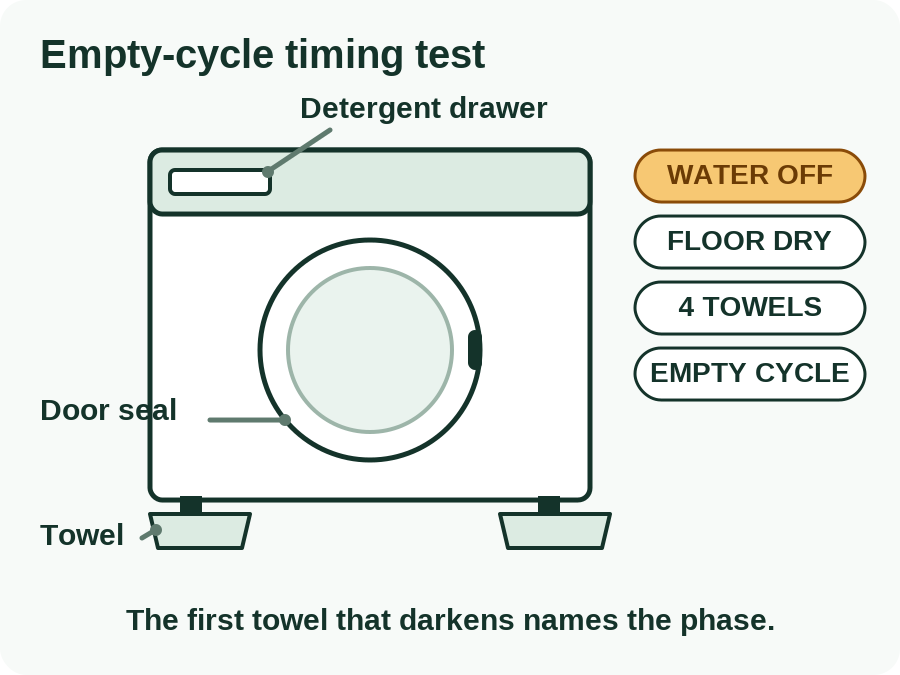
What the timing tells you:
- Wet during fill, at the back. The inlet side: a loose coupling, a missing or split hose washer, a cracked hose, or a failed inlet valve.
- Wet during fill, at the front or from the drawer. The dispenser is overflowing. GE says blocked ports make the fill water back up and spill; pods do not dissolve in the drawer.
- Wet during wash, at the front of the drum. The door boot is passing water. Samsung notes that even one strand of hair in the fold can cause a leak.
- Wet during wash, directly underneath, especially with a rusty stain. The tub seal or bearing is leaking. That is major disassembly, not a homeowner check.
- Wet during drain or spin, at the front corner or the back. The pump filter housing, drain hose, pump, or a backed-up standpipe.
- Wet only when the machine is off. The inlet valve is passing water. Keep the supply valves closed until it is repaired.
- No leak on the empty cycle. The leak is load-related: too much laundry, too much or non-HE detergent, an off-balance machine, or an item caught in the door.
The likely causes, in order
1. An inlet hose connection or washer
Whirlpool's checklist starts here: both ends of both inlet hoses need a rubber washer, and every connection has to be tight. A missing, hardened, or split washer weeps under pressure and looks much worse by the time it reaches the floor.
Confirm it: dry the coupling with a tissue, open the valve, and watch the joint for a minute. A damp tissue means the connection. Tighten by hand, then a quarter turn with pliers. Replace cracked hoses and hard washers; Whirlpool suggests new hoses every three to five years.
2. The drain hose or the standpipe
A drain hose can leak at the pump connection, split, or push water back out because the standpipe is blocked or sealed. GE says the hose needs a gap so air can enter; Samsung gives 6 to 8 inches of insertion and warns against an airtight connection. Follow your model's instructions.
Confirm it: run the drain and watch the back of the machine. If the floor stays dry but the standpipe overflows, the household drain is the problem. Pull the hose and pour a quart of water into the standpipe; GE says if it will not drain, call a plumber.
3. The pump filter or the drain pump
Front-load washers have a debris filter at the bottom front; Samsung recommends cleaning it monthly or every 40 washes. A clogged filter or an unseated cap leaks during drain; a cracked pump housing means a new pump.
Confirm it: open the filter door with a towel and a shallow pan underneath. Water will come out. Clean the filter, check the cap and O-ring, and look for cracks. If it still leaks from the pump body with the filter clean and seated, the pump is the source.
4. The door boot or the dispenser
On a front-loader, the rubber boot seals the door opening. Hair, lint, and detergent residue collect in the fold, and a tear or dislodged retaining ring lets water run down the front and under the machine. GE also describes a substantial leak from the dispenser: the tray fills, the ports that feed the drum are blocked, and water backs up and spills out.
Confirm it: open the door, pull the boot lip back, and look and feel around the circle. Clean the fold with a damp cloth. A tear or a boot that will not stay on the drum means replacement; Samsung directs a damaged door seal to service. For the dispenser, pull the drawer out and inspect the ports and the box behind it; clean both monthly and put pods in the drum.
5. The tub seal, bearing, or outer tub
If water appears directly under the middle during wash, the tub seal may be passing. On a top-loader it sits where the transmission shaft enters the basket; on a front-loader it is at the back centre. Water that reaches the bearing damages it, so the usual repair replaces both. This requires dismantling most of the washer.
Confirm it: water directly underneath, a rusty stain, and a rumble or grind during spin point this way. Stop here and book a technician.
When to stop and call a pro
- Water is at the cord, outlet, power strip, or breaker panel.
- The inlet valve drips when the machine is off.
- The tub seal, bearing, or outer tub is the source.
- The outer tub is cracked, or it has leaked for a long time.
- The washer is stacked, built in, or too heavy to move safely.
- The floor is soft or stained, or there is a sewage smell.
- The breaker trips when the washer starts.
- You ran the timing test and still cannot find the source.
An inlet hose, drain hose, pump filter, and dispenser tray are homeowner checks. A tub seal, bearing, outer tub, or stacked unit is not.
Narrow it down with FixThis
"Only on spin" and "only while filling" are different machines. Describe when yours leaks — add a photo if you have one — and FixThis will separate an inlet leak from a drain leak, then tell you what to check next and when to stop. The first two messages are free, and creating an account carries the conversation over.
---
Written from manufacturer documentation by the FixThis editorial team. FixThis is not a licensed plumber or appliance technician; this is general guidance, not an inspection. Procedures vary by model.
What's your specific symptom?
Describe what you're seeing or upload a photo.
You are texting the AI assistant for FixThis. It is not a licensed professional, and it gives general guidance — not professional inspection or diagnosis. If you smell gas, see active flooding, sparks, or fire, or believe there is immediate danger to people or property, leave the area and call 911 or your utility.
Sources
- https://producthelp.whirlpool.com/Laundry/Washers/Front_Load_Washers/Leaking/Leaking_from_Underneath_or_Bottom_-_Front_Load_Washer
- https://www.whirlpool.com/blog/washers-and-dryers/leaking-washing-machine.html
- https://products.geappliances.com/appliance/gea-support-search-content?contentId=17532
- https://products.geappliances.com/appliance/gea-support-search-content?contentId=23080
- https://www.samsung.com/us/support/troubleshoot/TSG10001007/
- https://partselect.com/blog/washer-leaking-from-bottom
- https://repairclinic.com/RepairHelp/How-To-Fix-A-Washing-Machine/45---/Washer-Leaking-Water