If the washer stopped with a full tub, the water is either not leaving the machine or not leaving the house. Check the drain hose first: a kink, an end pushed too far down the standpipe, or an airtight seal there is the most common cause, and Samsung says service is rarely needed for it. If the hose is clear, check the pump filter, then the pump. One 20-minute bucket test tells you which side of the cabinet you are on.
Safety first
- Unplug the washer before you touch the hose, the filter, or the pump. The pump terminals can be live, and the filter housing holds water.
- Hot-wash water is hot. Samsung says to let it cool for about an hour after a sanitize or hot cycle.
- The drain hose holds water. Lift its end over a container before pulling it out of the standpipe.
- A bucket fills fast. GE rates these pumps at 10 to 17 gallons a minute; a five-gallon pail is full in under a minute. Stop the cycle as soon as you know.
- Close the lid or door before you start the test, and keep hands out of the drum. The machine will not pump with the lid open.
- If water is at the cord, an outlet, or a power strip, switch the breaker off from a dry spot.
- If the washer is stacked, built in, or too heavy to move, stop here; the checks need the back of the machine.
Three failures that leave the same full tub
A washer that will not drain is usually one of three things, and they sound identical from the laundry room.
- Water cannot leave the house. The standpipe is blocked, the hose is pushed too far in and sealed, or its end sits higher than the pump can lift. The pump is fine.
- Water cannot reach the pump. The hose is kinked or crushed, the pump filter is packed with lint and hair, or an object is caught in the pump inlet. The pump may run or hum.
- The pump is not running. The lid switch or lock is not satisfied, the control is not sending power, or the pump has failed. The machine is silent, or hums without moving water.
All three leave a full tub and often the same code. The test below separates them by where the water gets to.
The bucket test
You need a large bucket or bin, towels, and about 20 minutes.
- Cancel the cycle and unplug the washer.
- Pull the drain hose out of the standpipe. Keep the end up, then lower it into the bucket. The hose is full; expect a spill.
- Plug it back in, close the lid or door, and start a Drain & Spin cycle (some models: Spin Only).
- Watch the end of the hose, not the drum. Stop the cycle as soon as you can see which result below you have.
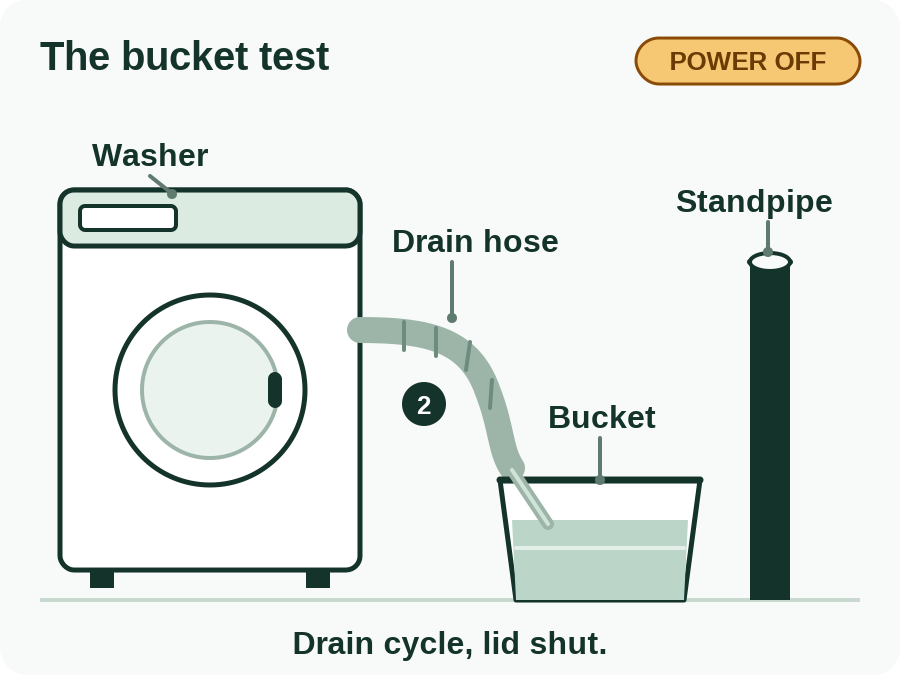
What the flow tells you:
- Strong, steady flow. The pump and hose work. The problem is downstream: the standpipe is blocked, or the hose was sealed or set too deep. Pour a quart into the standpipe — GE's check. If it will not go down, call a plumber.
- A trickle or nothing, with the pump humming. The blockage is between the tub and the pump: the filter, the pump inlet, or a kinked hose.
- Nothing, no pump noise, lid shut. The machine is not being told to drain. Check the display for a lid or door message; suspect the switch, lock, or control.
- Nothing, no noise, no error. The pump is not getting power. That needs a pump or control-board diagnosis.
Unplug the machine again when you are done.
The likely causes, in order
1. The drain hose is kinked, too deep, or sealed
Samsung calls incorrect drain hose installation the most common reason for drain issues, and says service is rarely required. The hose has to go a few inches into the standpipe and stop: Samsung gives 6 to 8 inches, GE 5 to 7, and Whirlpool no more than 5 on its stacked units. It must not seal the pipe — air has to get in, and a snug fit blocks flow or siphons. Height matters too: GE wants at least 30 inches above the base of a top loader (24 for a full-size front loader) and no more than 8 feet; Whirlpool gives 30 to 96 inches; Samsung says 18 inches minimum on its models. Check your installation instructions.
Confirm it: trace the hose from the pump to the standpipe. Straighten any kink, pull the end back to a few inches, remove tape or a seal, and rerun the test.
2. The standpipe or household drain is blocked
A strong bucket-test flow means the washer is fine and the house drain is not. Standpipes clog with lint and detergent residue, and a slow drain can back water into the machine.
Confirm it: pull the hose and pour a quart of water into the standpipe. If it drains slowly or backs up, that is a plumbing problem, not an appliance one.
3. The pump filter or a foreign object
Front-load washers have a filter behind a small door at the bottom front; Samsung notes that top loaders do not have a removable pump filter. GE notes that small items from pockets pass through to the pump, where a filter catches them until it clogs.
Confirm it: unplug the machine, put a towel and a shallow pan under the door. The housing holds water; some models have an emergency drain hose. Unscrew the filter, clean it, and check the impeller behind it turns by hand with the power off. If it will not, stop.
4. The lid switch or lid lock
Whirlpool lists the door or lid switch first among the reasons a washer will not drain or spin: the machine only pumps when it believes the lid is closed. On 1994 and older top loaders, GE says the lid must be down because those machines drain and spin together.
Confirm it: close the lid firmly and start Drain & Spin. If it fills and washes but will not drain, and the display shows a lid message, the switch or lock is the suspect. On most models that is a service part.
5. The drain pump
If the filter is clean, the hose is clear, and the bucket test still shows no flow with the pump humming, the pump or its inlet is the problem. GE sends that straight to service.
Confirm it: you cannot confirm this one at home. Replacing a pump means tipping the machine, removing the cabinet or front panel, and working around water and wiring.
6. Suds lock
Too much detergent, or non-HE detergent in a high-efficiency machine, can fill the tub with suds the pump cannot move. Whirlpool lists this among the causes.
Confirm it: the standing water is frothy or soapy and the load smells strongly of detergent. Let it settle, run a rinse and spin, and switch to HE detergent at the measured dose.
When to stop and call a pro
- Water is at the cord, an outlet, or a power strip.
- The breaker trips when the pump starts.
- The machine is stacked, built in, or too heavy to move safely.
- The tub is full and the pump only hums. GE directs this to service.
- The filter housing is cracked, or it will not seal after cleaning.
- The standpipe backs up when you pour water into it. That is a plumber.
- The drain hose is hard-piped, glued, or behind a cabinet you cannot reach.
- The filter is clean, the hose is clear, and it still will not drain.
A hose, a filter, and a detergent dose are homeowner checks. A pump, a lid lock, a control board, and a blocked house drain are not.
Narrow it down with FixThis
The details that decide this are small: the error code, whether the pump hums, how far the hose sits in the standpipe. Describe what yours is doing — add a photo of the display or hose — and FixThis will separate a house-drain problem from a pump problem, then tell you what to check next and when to stop. The first two messages are free; an account carries the conversation over.
---
Written from manufacturer documentation by the FixThis editorial team. FixThis is not a licensed plumber or appliance technician; this is general guidance, not an inspection. Procedures vary by model, so check your washer's manual.
What's your specific symptom?
Describe what you're seeing or upload a photo.
You are texting the AI assistant for FixThis. It is not a licensed professional, and it gives general guidance — not professional inspection or diagnosis. If you smell gas, see active flooding, sparks, or fire, or believe there is immediate danger to people or property, leave the area and call 911 or your utility.
Sources
- https://producthelp.whirlpool.com/Laundry/Washers/Product_Info/Washer_Product_Assistance/Washer_Not_Draining_or_Spinning%3F_Troubleshooting_Guide
- https://products.geappliances.com/appliance/gea-support-search-content?contentId=23081
- https://products.geappliances.com/appliance/gea-support-search-content?contentId=17516
- https://www.geappliances.com/ge/service-and-support/faq-washer.htm
- https://www.samsung.com/us/support/troubleshoot/TSG10007110/