If every tap went weak at once, the problem is at or before the main, not at the faucets. Screw a pressure gauge onto an outdoor hose bibb with every fixture off. Under about 40 psi, the fault is on the supply side: the pressure-reducing valve, the main shutoff, the meter, or the utility. A normal reading at rest that collapses when one tub runs means a restriction inside the house. Two readings, ten minutes, no disassembly.
Safety first
The risks are in the valves and the regulator, not in taking the reading.
- Do not force a stuck valve. The main shutoff and the meter valve often sit untouched for years. If the handle will not move, or the stem weeps when it does, stop. Forcing it can break the valve and leave you unable to shut the water off.
- Do not set a regulator by feel. Watts' instructions call for a pressure gauge to verify the setting and warn against bottoming out the adjusting screw. A quarter turn at a time, gauge on.
- Do not add air to a well tank that has lost its charge. Amtrol's manual says not to re-pressurize after a loss of air, visible corrosion, or a drop in pump cycle time: the tank can rupture. That is a well contractor's call.
- Above 80 psi is the opposite problem. EPA notes most U.S. plumbing codes require a reducing valve above 80 psi, and that high pressure damages piping, fixtures, and appliances. Do not chase low flow by raising pressure.
Pressure is not flow
Portland's water bureau puts it plainly: pressure is force, measured in psi; flow is volume, measured in gallons per minute. What you feel at a tap is flow, and a choked pipe gives poor flow at normal pressure. That is why the first test is a gauge, not a faucet.
Before the gauge, compare hot with cold at one tap, then one tap with all the others. Hot only points at the water heater. Some taps normal points at a fixture. Every tap, including the outdoor spigot, points at the whole house.
The two-reading hose-bibb test
You need an inexpensive hose-thread gauge, a towel, and ten minutes. EPA's WaterSense procedure: attach the gauge to a hose bibb, the cold tap at the washing machine, or a first-floor cold tap, and open the water fully.
- Shut everything off: faucets, dishwasher, washing machine, ice maker, irrigation, hose.
- Screw the gauge on hand-tight, a quarter turn more with a cloth if it weeps. No wrench on the body.
- Open the bibb all the way and read. This is static pressure, the force with nothing moving. Write it down.
- Leave the gauge on, open the cold side of a bathtub fully, and read again. This is flowing pressure.
- Close everything and remove the gauge.
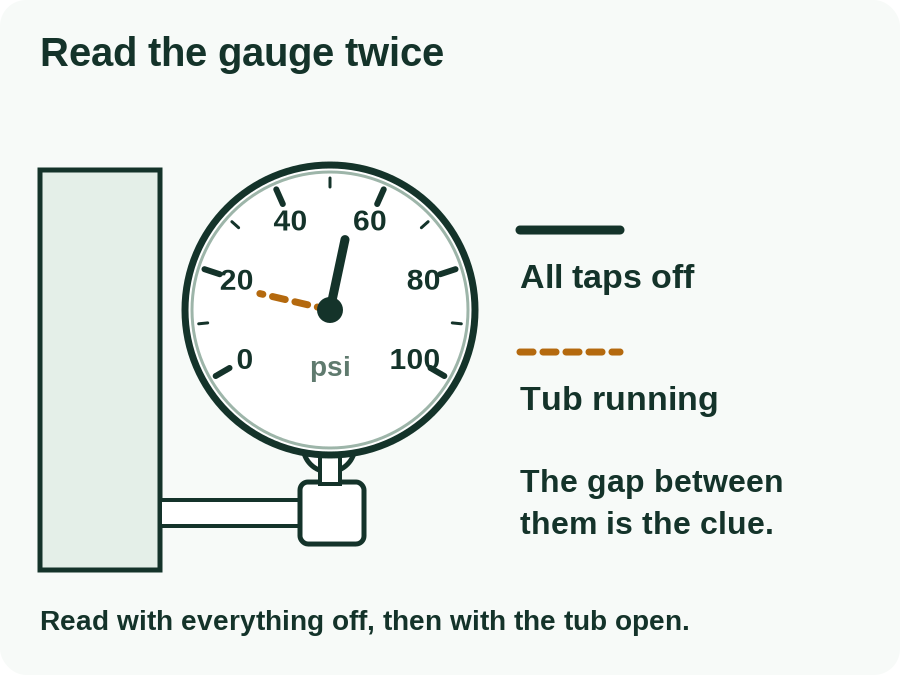
What the two numbers mean:
- Static below about 40 psi. Weak supply before your fixtures; EPA's target is 45 to 60 psi. Call the utility first. Portland can look up the expected range for an address, and a sudden drop with discoloured water can mean a main break.
- Static in range, flowing collapsing to 15 or 20 psi. A restriction inside: whole-house filter, softener, part-closed valve, or scaled pipe.
- Static in range, flowing barely moves, one tap weak. Not a whole-house problem. Clean that aerator or cartridge.
- Static above 80 psi. The regulator is stuck open or missing. That is the urgent repair: EPA notes high pressure damages piping, fixtures, and appliances.
- The needle falls toward zero while the pump runs, then climbs. On a well, a tank or pump problem.
Three causes that look identical
- The reducing valve is set low or has failed. Everything weak, evenly, all the time.
- The main shutoff or meter valve is part-closed. Everything weak, but static can look almost normal while flow collapses when a second tap opens.
- Something inside the house throttles the pipe. Filter, softener, scale: static normal, flow poor, worst at the farthest fixtures.
All three present as "the whole house is weak." They need a plumber, the utility, and either a filter change or a repipe.
The ranked causes, and how to confirm each
1. The pressure-reducing valve
It sits on the main after the shutoff, usually where the service enters: a bell-shaped brass body with an adjusting screw on top and often a strainer plug underneath.
Confirm it: static low, a regulator present, and the utility says street pressure is normal. Watts lists insufficient pressure or flow as a sign its valve needs maintenance, and ships residential valves preset to 50 psi. A failed valve passes less and less water; a misadjusted one is simply set low.
Adjust with the gauge downstream: loosen the lock nut, a quarter turn clockwise, re-read. If a full turn changes nothing, the valve is not responding. Stop there. Replacement is a cut-and-solder or press-fit job on the main.
2. The main shutoff or meter valve
A gate valve 90 percent open looks open. A ball valve handle at 45 degrees is half closed, and a handle left part-open after other work produces exactly this.
Confirm it: find the shutoff in the basement, crawlspace, utility closet, or at the meter. A gate valve turns counterclockwise until it stops; a wheel that turns with no resistance and no change in flow may have a broken stem. A ball valve is open when the handle is parallel to the pipe. If the valve at the meter is the suspect, it is the utility's. Call them; do not cut the meter seal.
3. A whole-house filter or softener
Both sit in the main line and throttle flow when loaded or failing. Scottsdale's water department gives the test: bypass the appliance, recheck at the hose bibb. If pressure returns, the appliance is the culprit.
Confirm it: bypass the softener or replace the filter cartridge, then repeat the flowing reading. A housing nobody has opened in years is a strong suspect, and a softener that happens to be regenerating should be retested once it finishes.
4. Scaled or corroded galvanized pipe
A gradual decline over years, an older house, rusty water at the first draw. Portland names corrosion as a cause of restricted flow in older galvanized plumbing: the bore closes from the inside.
Confirm it: static normal, flowing poor at a distant fixture, the supply pipe is steel rather than copper or PEX, and a magnet sticks to it. A plumber confirms with readings at the meter and at the fixtures. There is no cleaning fix; the pipe is replaced.
5. On a well: the tank or the pump
A waterlogged tank, a failing pump, or a bad switch reads as weak, surging pressure. The tell is the needle moving with nothing open; a pump that cuts in and out every minute or two is short cycling.
Confirm it: watch the gauge for two minutes with every fixture closed. Note the ceiling, the floor, and the time between cycles. Do not add air yourself. Amtrol warns that re-pressurizing a tank that lost its charge or shows corrosion can rupture it.
When to stop and call a pro
- The regulator does not respond to a quarter turn, or its body is corroded or weeping.
- The main shutoff will not turn, or weeps at the stem when it does.
- The suspect valve is at the meter. That one is the utility's.
- The house has galvanized supply pipe and pressure has faded for years. That is a repipe.
- You are on a well and the tank lost its air charge, shows corrosion, or the pump short-cycles.
- Static pressure stays above 80 psi after an adjustment.
- Water is discoloured, or a neighbour has the same sudden drop. Call the utility first.
Work it out with FixThis
The two numbers do most of the work. "Fifty with everything off, twenty with the tub running" points inside the house. "Thirty with everything off" points at the supply. Add whether hot and cold differ, and whether the outdoor spigot is weak too, and the shortlist gets very short.
Describe yours, and a photo of the gauge dial helps. FixThis asks the questions that separate those cases, then tells you what to check next and when to stop. The first two messages are free, and an account keeps the conversation.
---
Written from EPA, municipal water utility, and manufacturer documentation by the FixThis editorial team. FixThis is not a licensed plumber; this is general guidance, not an inspection. Pressure settings and valve procedures vary by model and by local code.
What's your specific symptom?
Describe what you're seeing or upload a photo.
You are texting the AI assistant for FixThis. It is not a licensed professional, and it gives general guidance — not professional inspection or diagnosis. If you smell gas, see active flooding, sparks, or fire, or believe there is immediate danger to people or property, leave the area and call 911 or your utility.
Sources
- https://www.epa.gov/watersense/home-maintenance
- https://www.epa.gov/system/files/documents/2023-08/ws-homes-TRM-12-ServiceWaterPressureTechSheet.pdf
- https://www.portland.gov/water/drinking-water-quality/troubleshooting-drinking-water-quality-home/water-pressure-and-flow
- https://www.scottsdaleaz.gov/water/water-service/maintenance-prevention-troubleshooting
- https://www.watts.com/dfsmedia/0533dbba17714b1ab581ab07a4cbb521/11958-source/638818138770000000/1911439-pdf.pdf
- https://www.amtrol.com/wp-content/uploads/2025/08/9015-868-MC10185-07_25-WXT-IO-manual.pdf